
Every business has a number it lives by.
Not the number it reports in board meetings. Not the one that goes in the quarterly update or the investor deck. The one that the founder checks first thing in the morning, before coffee, before email, before anything else. The one that tells them, in a single glance, whether today is going to feel like progress or damage control.
For most of the founders I have worked alongside, that number is revenue.
Which seems reasonable. Revenue is real. Revenue pays salaries. Revenue is the number everyone understands and nobody argues about. When it goes up, the mood in the office goes up with it. When it dips, you can feel the shift in the room before anyone says a word.
The problem with revenue as your north star is not that it is wrong. It is that it is late. By the time revenue tells you something is broken, the thing has usually been broken for quite a while. You are reading yesterday’s news and calling it a strategy.
The number that nearly killed a business I watched closely.
I have seen this pattern more times than I would like. A founder, sharp and genuinely hardworking, optimising for top line growth at the expense of almost everything else that actually mattered.
Order volume up. Great. Margins quietly compressing. Less great, but we will fix it later. Customer acquisition costs creeping higher every quarter. Fine, we are scaling. Return rates ticking up in a category where returns are expensive and the signal is almost always product-market fit eroding at the edges. Noticed. Noted. Moved on.
The spreadsheet looked healthy. The business was not.
The moment I understood how badly the situation had been misread was not a dramatic one. There was no single crisis, no missed payroll, no emergency board call. It was a conversation where someone pulled up a number that had not been looked at closely enough in months.
Contribution margin per order. Not revenue. Not gross margin. The actual amount of money left over after accounting for the cost of the product, the cost of getting it to the customer, the returns, the platform fees, the advertising spend that attributed itself to that order in the dashboard whether it deserved to or not.
The number was wrong. Not catastrophically wrong. Just quietly, persistently, getting-worse-every-quarter wrong. And because revenue was fine, nobody had been panicking. The business had been growing into a margin structure that was going to become a serious problem at exactly the moment it least needed one.

The number that saved us.
We started measuring contribution margin per order seriously at Ergode some years ago, and everything changed about how we made decisions.
Not because it gave us easy answers. It gave us honest ones, which is considerably more useful and considerably less comfortable.
We had products that looked like winners on revenue and were quietly destroying value on contribution. We had marketing channels that showed strong ROAS in the dashboard and terrible economics when you traced the full cost of the customer all the way through. We had geographies that felt like growth and were actually just importing our cost structure into markets that could not support it.
None of this was invisible. All of it was hiding in plain sight behind a revenue line that was moving in the right direction.
The moment contribution margin per order became the number we ran the business on, we made three decisions in the first month that we had been circling for the better part of a year. One product line got restructured. One channel got cut. One market entry got paused.
Revenue dipped slightly in the short term. Every other number that actually mattered improved.
Why is the wrong metric so dangerous?
Here is the thing about optimising for the wrong number. It does not feel wrong while you are doing it. It feels like focus. It feels like discipline. You have a goal, you are working toward it, the number is moving. The fact that it is the wrong number is almost impossible to see from inside the momentum of chasing it.
The businesses I have watched get into real trouble are almost never the ones that were not working hard enough. They are the ones that were working extremely hard in a direction the numbers were not honestly pointing them.
A metric is not just a measurement. It is a signal about what you believe matters. And if what you believe matters is slightly wrong, everything you build on top of that belief will be slightly wrong too. At a small scale that is manageable. At the scale you are trying to reach, it compounds into something considerably harder to unwind.
Choose the number you run your business on with the same care you would choose the foundation of a building. Because everything else sits on top of it. And a foundation that looks solid from the outside while quietly shifting underneath is the most expensive kind of problem to discover late.
What I know now.
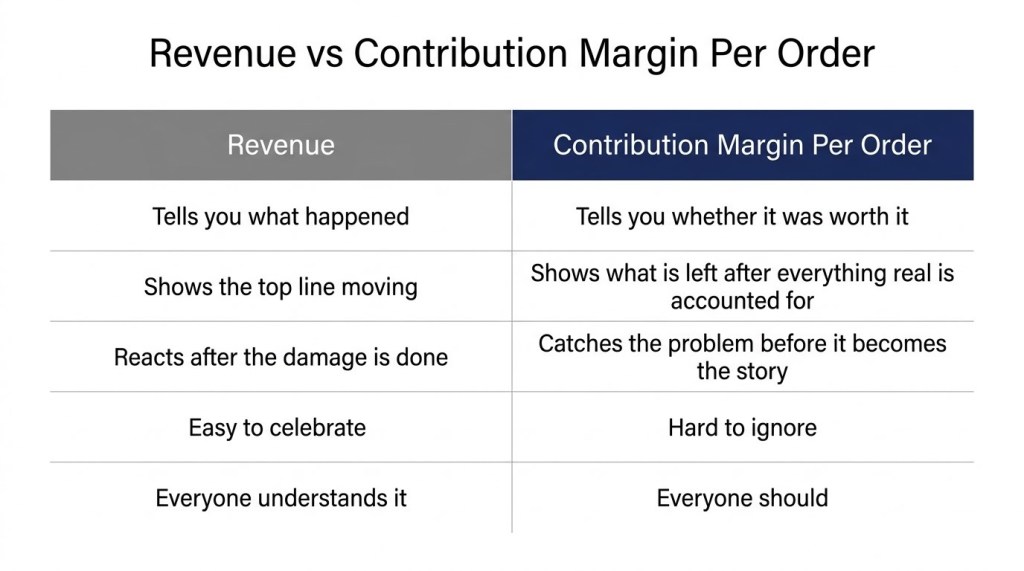
Revenue tells you what happened. Contribution margin tells you whether it was worth it.
Both matter. But only one of them will catch the problem before it becomes the story.
The metric that nearly killed that business was not a bad number. It was just an incomplete one. And confusing completeness with accuracy for long enough costs time, margin, and a few decisions that would have looked very different with the right information in front of them.
The one that saved us was always available. We just had to decide it was important enough to lead with.
That decision, made earlier, is worth considerably more than anything you are currently optimising for.
Regards,
Rupesh
Discover more from Cloverbites By Rupesh Sanghavi
Subscribe to get the latest posts sent to your email.

Leave a Reply