
Priya was one of our best. Sharp, reliable, the kind of person who fixed problems before you even knew they existed, and then quietly did not mention it because she was not the type to make a thing of it. Two years in. Good reviews every single cycle. If you had asked me to rank the people least likely to surprise me, she would have been near the top of that list.
On a Tuesday, she asked for fifteen minutes. I assumed a client escalation, because that is usually what fifteen minute meetings were about back then. She sat down, thanked me for the opportunity, and told me she was resigning. Last day in two weeks. No negotiation, no back and forth, because she had clearly made peace with the decision long before she walked into my office.
I asked why, the way every founder does in that moment. She gave me a polite, well rehearsed answer about growth and new challenges, the professional equivalent of “it is not you, it is me.” I thanked her for her contribution, wished her well, and then spent the rest of the day turning the conversation over in my head, not because anything had gone visibly wrong, but because I could not shake the feeling that I had missed something happening right in front of me.

What resignations actually are
Here is the thing nobody tells you about good employees leaving. It is almost never a decision. It is an announcement of a decision that was already made, sometimes weeks earlier, in a part of their head you were never invited into.
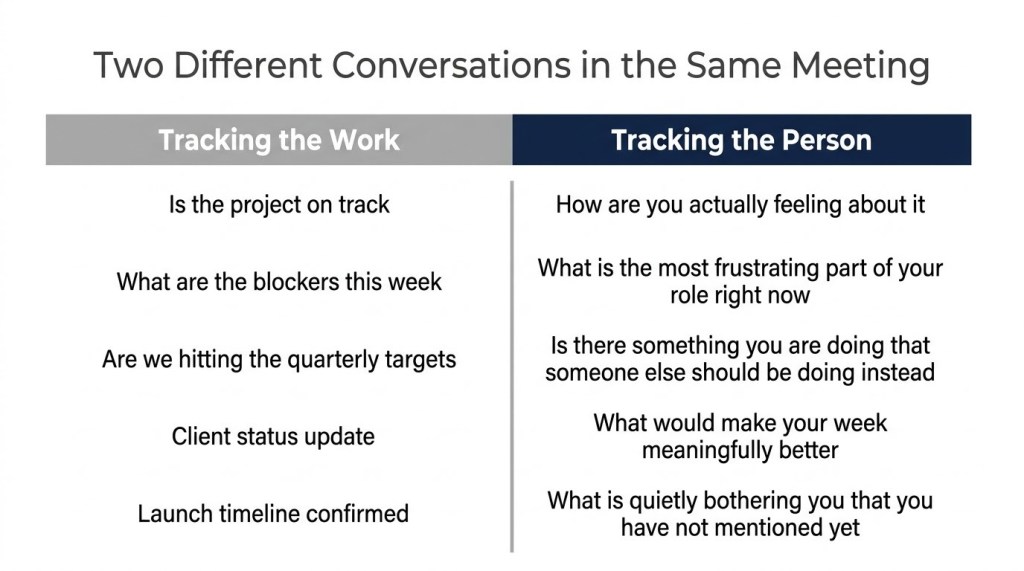
I went back through our one on ones from the last six months, mostly out of curiosity about what I might find. They were almost entirely status conversations. Client status. Launch blockers. Are we on track for the quarter. Efficient, well structured, the kind of meeting that looks great on a calendar. And also, I realised, built entirely to track the work, never the person doing it. Two completely different instruments, measuring two completely different things, both quietly living on the same weekly invite.
It reminded me of my father and our old car, which he swore he “regularly maintained” by checking whether it started in the morning. If it started, maintenance was complete for the week. He never once looked under the hood. The car had its own opinion about that arrangement and expressed it, loudly, on a highway one afternoon, at a spectacularly inconvenient time. Some things run perfectly fine right up until the moment they do not, and give you almost nothing in between to go on.
Why the best people are the hardest to read
The strongest performers are usually the least likely to complain out loud. They tend to process things privately, weigh their options quietly, and only speak once they have already landed somewhere. Which means by the time you hear anything at all, you are rarely being given a chance to respond. You are simply being informed.
That is not a flaw in how people communicate. It is just how a lot of thoughtful, self-sufficient people operate, and it means the usual signals you wait for, complaints, visible frustration, a dip in output, may never show up at all before someone is already gone.
So the interesting question is not how to react faster once someone tells you something. It is what you would need to be asking, long before there is anything to react to. Small questions. Slightly odd ones. “What is the most annoying part of your week right now.” “Is there something you are doing that someone else should probably be doing instead.” Questions that catch people off guard enough to get an honest answer instead of a rehearsed one.
Some weeks the answer is boring, a clunky process, a mildly annoying tool. Other times it tells you something is quietly shifting, long before it would ever show up as a resignation letter.

The part I still think about
A few months after Priya left, I ran into her at an industry event. No awkwardness, no hard feelings, we caught up like old colleagues do. I finally asked her the honest version of the question. What actually made you leave.
She said something simple. “Nobody ever asked me how I was doing. Only how the work was doing.” I still think about that sentence more than most advice I have paid consultants good money for.
Good people rarely make noise on their way out. The resignation, when it finally arrives, is more of a headline than a plot twist, and the actual story was written quietly, weeks or months earlier, somewhere just out of view. It is less a puzzle to solve once and more a habit to keep practicing, one slightly odd question at a time, because people are always changing quietly, and the only way to notice is to keep asking.
Regards,
Rupesh
Discover more from Cloverbites By Rupesh Sanghavi
Subscribe to get the latest posts sent to your email.

Leave a Reply