
I was in Singapore two weeks ago, jet lagged and slightly lost, trying to order room service through my phone. I did not open the hotel app. I did not Google the menu. I just told my AI assistant what I was in the mood for, roughly what I did not want, and asked her to sort it out.
It did. In about forty seconds.
I sat there waiting for the food and thought about the brand whose product just got recommended to me without a single piece of their marketing touching me. No ad. No page visit. No carefully optimised listing. Just a system that parsed some data, made a call, and moved on.
And then I thought about all the brands whose products did not get recommended. Not because they were worse. Because the system could not read them clearly enough to be confident.
That is the whole thing, right there, in a hotel room in Singapore at midnight.

The customer did not disappear. They just stopped doing the work.
Here is what actually changed.
For as long as e-commerce has existed, the customer did the labour of shopping. They searched. They scrolled. They compared. They read your description, looked at your photos, checked your reviews, weighed you against the option two listings down, and eventually made a call.
That labour is now being delegated. Not to another person. To a system that does it faster, more consistently, and without the emotional variability that makes human shopping decisions so interesting and so hard to predict.
The customer is still making the final call. But the shortlist they are choosing from was assembled by something that never visited your page, never saw your hero image, and genuinely does not care how good your copywriter is.
It cares about one thing. Whether it can read you clearly enough to recommend you without risk.
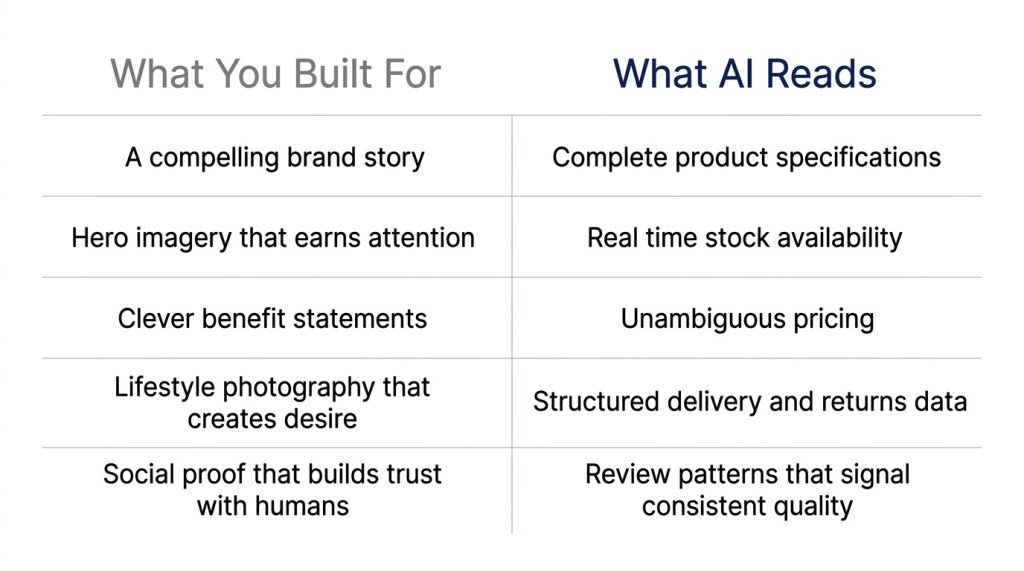
What the system is actually reading.
Not your brand story. Not your tone of voice. Not the lifestyle imagery that took three shoots to get right.
Specifications. Exact ones. Pricing with no ambiguity. Stock availability in real time. Delivery windows that are stated clearly and kept consistently. Review patterns that signal reliable quality rather than a burst of five stars from launch week followed by silence.
The AI doing the shopping on your customer’s behalf is trying to answer a specific question accurately. Does this product genuinely match what my customer asked for? It rewards the seller who makes that question easy to answer. It moves past the seller who makes it complicated, regardless of how beautiful the rest of their page is.
Two listings can look identical to a human shopper and perform completely differently in front of a system, purely based on how cleanly the underlying data is structured. The seller who fills every specification field completely and accurately will get recommended. The seller who leaves fields vague or blank will not make the shortlist, and will never know why.
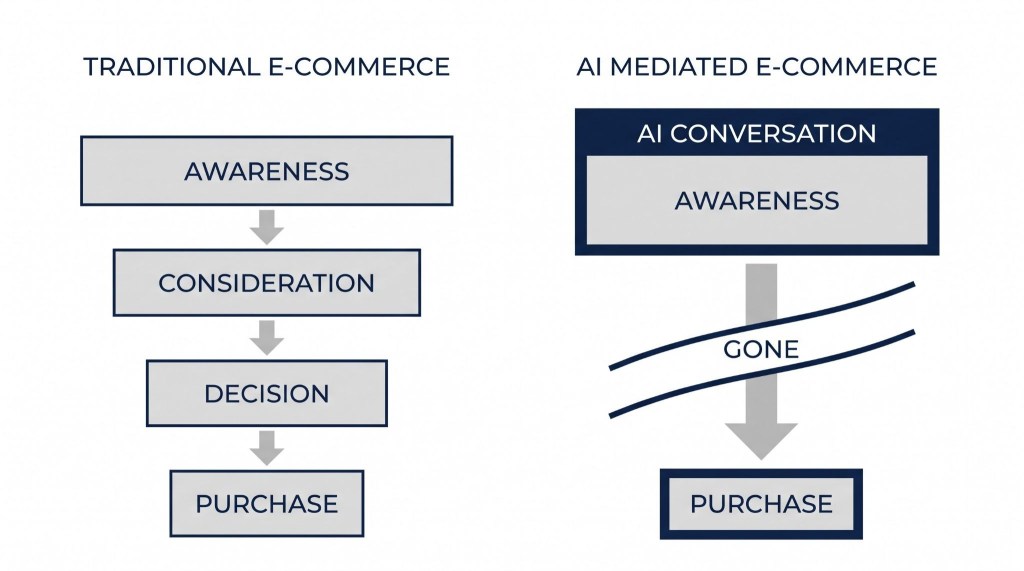
The middle of the funnel just disappeared.
This is the part most businesses have not caught up to yet.
The traditional e-commerce funnel had a middle. Awareness, then consideration, then decision. And the consideration phase, the part where a customer was on your page, reading, weighing, deciding, was where most of the real work of selling happened. Better copy. Better images. Better social proof. All of it designed to win a human in that specific window.
That window is getting shorter. For a growing number of purchases, it is gone entirely.
The awareness stage now happens inside an AI conversation. The consideration stage happens in the same conversation. The shortlist is assembled. The customer approves it. The purchase happens. You did not get a visit. You did not get an impression. You either made the list or you did not, and the decision was made without you.

What this actually means for your business.
It means your product data is now a sales asset, not an admin task.
Every specification field you left blank because you ran out of time at launch. Every delivery term buried in a FAQ page nobody reads. Every return policy written in language a human can interpret but a system cannot parse cleanly. All of it is now costing you sales you will never see on a dashboard, from customers you will never know you lost.
The businesses moving fastest in this environment are treating their product infrastructure with the same seriousness they treat their marketing. Not because someone told them to. Because they noticed, usually after a conversation like the one I had in that Singapore hotel room, that the game had quietly changed while they were busy optimising for a customer behaviour that is becoming less common every quarter.
The question is worth asking before next month.
If an AI assistant were shopping in your category right now, on behalf of someone who already knows roughly what they need, would your product make the shortlist?
Not because of your brand. Because of your data. Because of the clarity and completeness of what you present to a system that has no patience for ambiguity and no loyalty to anyone.
If the honest answer is that you are not sure, that is not a marketing problem. It is a data problem. And the good news is that it is a solvable one, if you decide it is worth solving before your competitors do.
Your customer already delegated the purchase.
The only question left is whether you were ready for that.
Regards,
Rupesh
Discover more from Cloverbites By Rupesh Sanghavi
Subscribe to get the latest posts sent to your email.

Leave a Reply