
On June 1, 2009, an Air France Airbus A330 over the Atlantic lost its airspeed readings. The autopilot, doing exactly what it was built to do, handed control back to the pilots. Less than a minute later the aircraft was outside its flight envelope. All 228 people on board died.
The final investigation report, published in 2012, found that neither pilot had been trained to hand-fly the aircraft at high altitude or to fly with unreliable airspeed data. It faulted the crew’s actions, and it also found that their training met the standards of the day.
I think about that report whenever someone tells me AI means we no longer need to understand the thing it does.
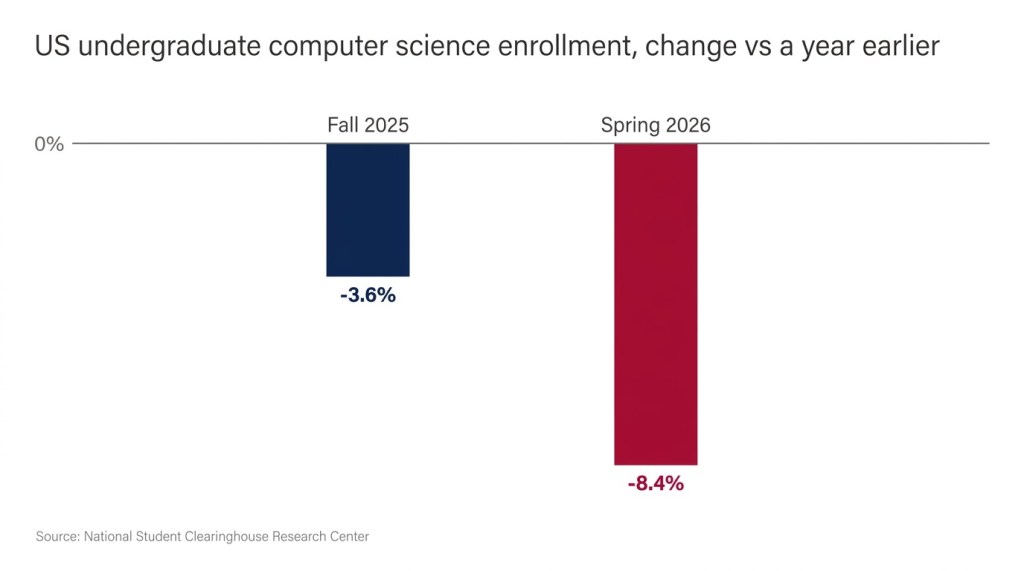
Here is the number behind that conversation. According to the National Student Clearinghouse Research Center, as reported by Fortune on August 6, undergraduate enrollment in computer and information sciences at four-year US institutions fell 8.4 percent in spring 2026 compared with a year earlier. That followed a 3.6 percent drop in fall 2025. Graduate enrollment in the field fell 14 percent over the same period.
The Worry Makes Sense
Students are not being foolish. They watch AI tools produce working software in minutes. They hear that employers are rethinking entry-level hiring. If you are 18 and about to sign up for four years, you want a lane that still exists when you graduate.
The instinct is rational. The conclusion is what I would question.
The Autopilot Problem
Autopilot is excellent. It is also the first thing to hand you the controls at the worst possible moment.
Nobody looked at that report and decided pilots were obsolete. The job changed from flying the plane to supervising it, and supervision turned out to be the skill that matters most, because it is the one you need when the machine is wrong.
Code is heading the same way. AI writes the first draft. Someone has to read it, test it, and know when it is confidently wrong. Nobody can do that without understanding what code is and how it fails.
David Watts, director of Colby College’s Davis Institute for Artificial Intelligence, told Fortune: “I’m not an advocate to say that computer science is no longer needed.” His point is that how the knowledge is applied is changing, and that engineers still need to know when AI has got it wrong.
The Number I Trust
I see a small version of this at Ergode. We run on one number, contribution margin per order. I wrote in August about the day we put it ahead of revenue, here. Revenue had looked fine while the business underneath was getting worse.
Software, or an AI, can calculate that number in seconds. It could not decide that it was the number that mattered, and it would not tell you that this quarter’s version looks wrong. That judgment came from people who understood how the business makes money. The tools only did the arithmetic.
That is the skill I would not want a young person to skip.
What I Would Tell a 17-Year-Old
Not that everyone should become a software engineer. Something more practical.
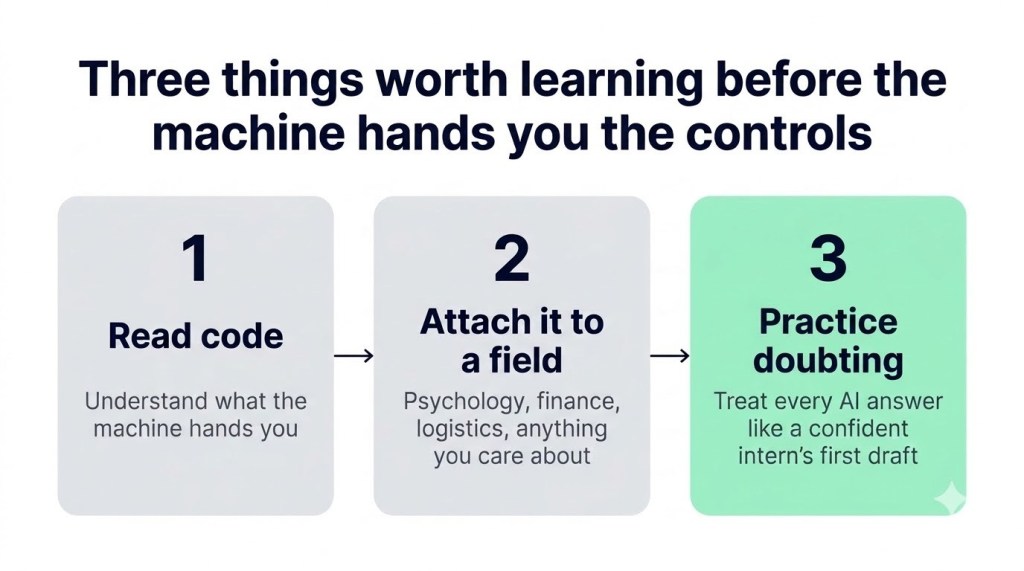
Learn enough code to read it. Not to make a living by typing it, but to understand what the machine hands you.
Then attach it to something you care about. Watts gave the example of a psychology student who could build AI tools for behavioral health. A coder who knows nothing else is easy to replace. Someone who understands a field and can direct the machine inside it is much harder to replace.
And practice doubting. Treat every AI answer like a confident intern’s first draft: neatly formatted, full of certainty, and occasionally wrong about where the office is. Judgment is the skill that will matter, and it grows from knowing the underlying thing well.

Where I Could Be Wrong
Two semesters of falling enrollment is a signal, not a verdict. Students may be reacting to fear more than to real hiring outcomes.
The tools may also improve faster than I expect. If checking AI’s work becomes rare, fewer people will need deep technical knowledge, and the autopilot comparison weakens. Perhaps only a small group needs to understand code in depth, while everyone else needs the judgment without the syntax.
I would rather say that plainly than pretend to certainty.
If you have a teenager, are a student yourself, or hire graduates, I would like to know which side you are on. Would you still push a young person towards code, and why? Tell me on LinkedIn.
Regards,
Rupesh
Discover more from Cloverbites By Rupesh Sanghavi
Subscribe to get the latest posts sent to your email.

Leave a Reply