
Do you ever ask an AI what to buy and then go buy it somewhere else?
You are not alone. Most people do exactly that. They ask. They get a recommendation. They take that recommendation to a search bar, or a marketplace, or a brand website, and they complete the purchase themselves, in a place they already know and already trust.
It is a completely rational behaviour. The AI did the hard part. The research, the comparison, the shortlisting. The human did the comfortable part. The actual buying, in a familiar environment, with a payment method they trust and a returns process they understand.
What this behaviour produces, at scale, is one of the most interesting gaps in commerce right now.
65% of consumers trust AI to compare products and make recommendations. Only 14% trust it to complete the purchase on their behalf.
That gap is not a problem. It is the most underutilised opportunity most e-commerce businesses are sitting on right now.

What the gap is actually telling you.
People are not sceptical of AI’s ability to find the right product. They are sceptical of AI’s ability to handle the consequences if something goes wrong.
What if the size is wrong? What if it arrives damaged. What if I need to return it? What if the payment fails. What if I change my mind at eleven at night and I am not sure who to call.
These are not irrational fears. They are the exact anxieties that every mature e-commerce brand has spent years building infrastructure to address. The easy return. The clear refund policy. The customer service team that actually responds. The tracking link that works.
The 14% who trust AI to buy already have answers to those questions. They have had enough good experiences, with reliable enough brands, that the anxiety has been replaced by confidence.
The 51% gap in the middle is people who trust the recommendation but not yet the execution. And that gap is yours to close, if you understand what is actually sitting inside it.
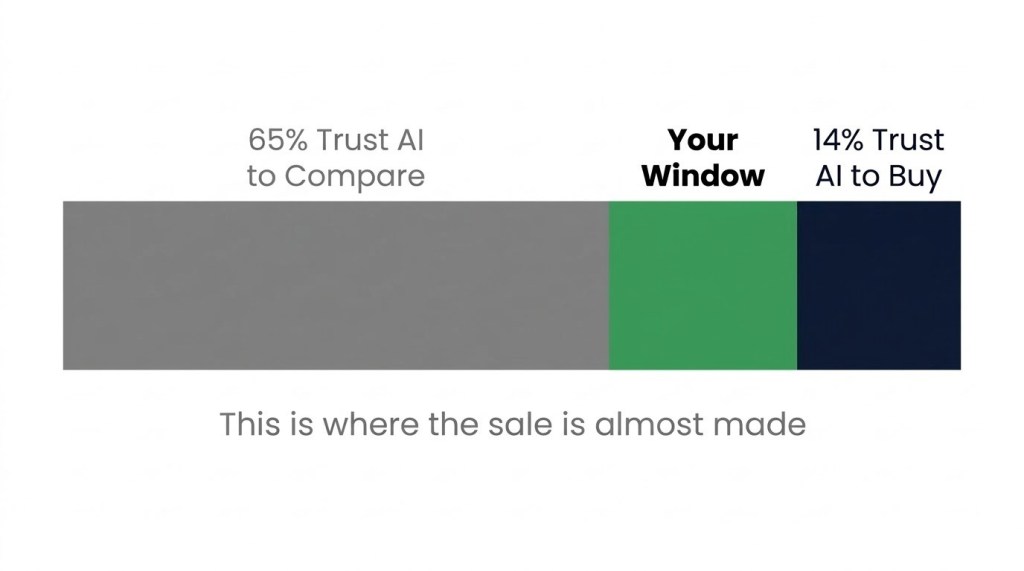
Where the real sale is happening.
Here is something most sellers are missing.
The moment the AI makes a recommendation, the sale is almost made. The customer has already been convinced. They have delegated the research. They have accepted the shortlist. They are holding the answer in their hand.
What they are looking for now is not more persuasion. They are looking for permission to complete the purchase without anxiety.
That permission comes from very specific things. A returns policy that is written in plain language and is genuinely easy to action. Delivery estimates that are accurate rather than optimistic. A brand presence that signals this is a real company that will pick up if something goes wrong. Reviews that are recent, consistent, and specific rather than vague and obviously coached.
None of this is new information. All of it is the operational baseline that serious e-commerce brands have been building for years. What is new is that it now needs to be legible not just to a nervous human on your page, but to an AI system that is deciding whether to hand your product to that nervous human in the first place.
The compounding advantage nobody is talking about.
Here is where it gets interesting.
The brands that close the trust gap do not just win more sales. They get recommended more often. Because AI systems learn from outcomes. A brand whose products arrive on time, match their descriptions, generate positive review patterns, and rarely trigger returns is a brand an AI agent can recommend with confidence. Again and again. To customer after customer who never visits the page and never reads the copy.
That is a compounding advantage. Every reliable transaction makes the next recommendation more likely. Every broken promise makes the next recommendation less likely. And the feedback loop runs quietly, continuously, without anyone at the brand necessarily knowing it is happening.
The businesses building this reputation now are not just winning the customers in front of them. They are training the systems that will send them customers for years.

What to actually do with this.
Start with the anxiety, not the recommendation.
The customer already trusts the AI to find the right product. Your job is to remove every reason they might hesitate at the moment of purchase. Clear returns. Accurate delivery. Consistent quality. A brand that feels real and reachable.
Then make all of it legible to a machine. Structured data. Complete specifications. Delivery and returns terms that a system can parse in a second rather than a human can squint at for thirty.
The 65% who trust AI to compare are already halfway to buying from you. The question is whether the other half of that journey, the part that happens in the 51% gap between comparison and purchase, is as well built as your product page.
Most brands have spent years on the product page. Almost nobody has thought seriously about the gap.
That is your window. It is open right now. And the brands that climb through it first will find it considerably harder for anyone else to follow.
Regards,
Rupesh
Discover more from Cloverbites By Rupesh Sanghavi
Subscribe to get the latest posts sent to your email.

Leave a Reply