Culture is the thing every company says it cares about and almost nobody can explain precisely how to build.
You can write the values on a wall. You can put them in the onboarding deck. You can repeat them in every hand until the words lose meaning from overuse. And still, culture remains stubbornly difficult to engineer directly, because culture is not a document. It is the sum of thousands of small decisions people make when nobody is watching and nothing is forcing them to make the right one.
Which raises an uncomfortable question. If culture cannot be written into existence, what actually shapes it.
I have come to believe ownership is one of the most underrated answers.
The behaviour that changes first.
The most visible shift when people hold real equity is not how hard they work. Most good people already work hard, equity or not. The shift is in how they talk about the business.
Listen closely to a meeting in a company where ownership is concentrated entirely at the top, and you will hear a particular kind of language. We versus they. The founders versus the team. Decisions framed as things that happen to people rather than things people are part of shaping.
Now listen to a meeting in a company where ownership is genuinely distributed, where a meaningful number of people hold equity that matters to them. The language changes. We start to mean something different. Decisions get discussed with the kind of scrutiny people reserve for their own money, because in a very real sense, it now is.
That linguistic shift sounds small. It is not. Language is one of the clearest signals of how people actually relate to the thing they are building, and it is very difficult to fake for long.
Why ownership creates accountability that policy cannot.
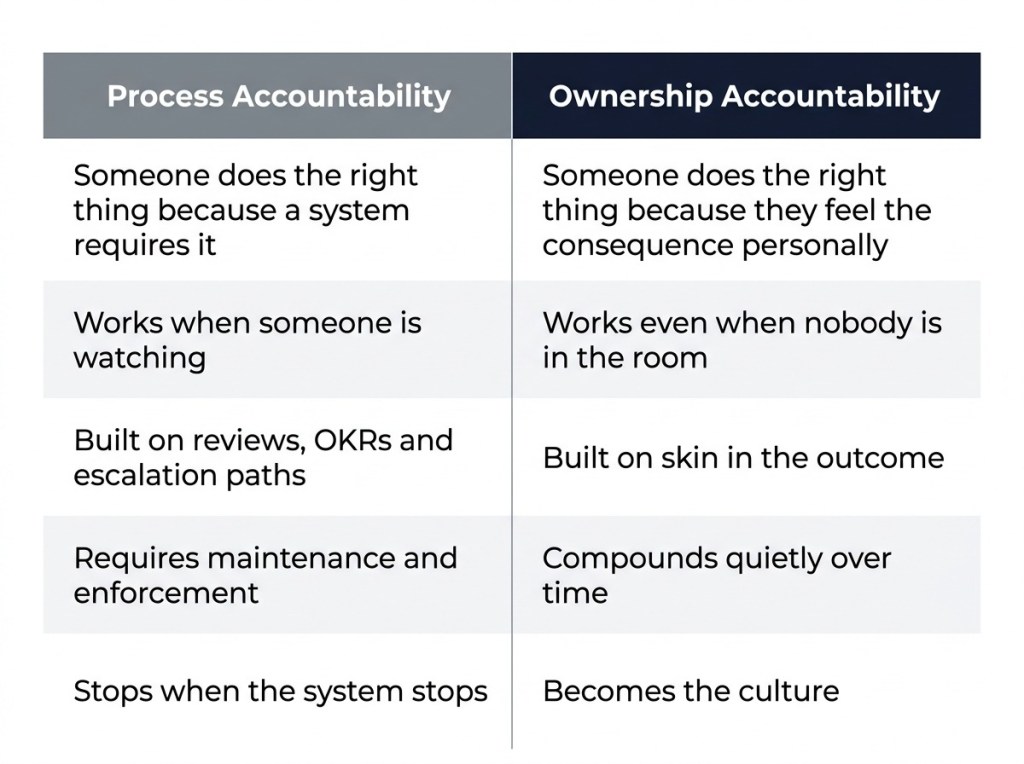
Every company tries to build accountability through process. Performance reviews, OKRs, dashboards, escalation paths. All useful. None of them create the thing that genuine ownership creates almost automatically, which is a person who holds themselves accountable because they have skin in the outcome, not because a system is checking on them.
There is a meaningful difference between someone doing the right thing because a process requires it and someone doing the right thing because they would feel the consequence of not doing it, personally and financially, in a way that has nothing to do with whether anyone is watching.
The businesses with the strongest cultures I have observed, are rarely the ones with the most elaborate accountability systems. They are the ones where enough people have a genuine stake in the outcome that the system becomes almost unnecessary. The ownership does the work the process was trying to do, except it works even when nobody is in the room.

The risk nobody talks about.
This is not a uniformly easy story. Giving people real ownership also means giving them real opinions, and those opinions do not always align with where leadership wants to go.
A team member with meaningful equity is more likely to challenge a decision they think is wrong, because the cost of staying quiet is now partly theirs to bear. That can feel uncomfortable for a founder used to making calls without much pushback. It requires a different kind of leadership, one that can hold its ground when it needs to and genuinely update its thinking when the pushback is right.
The businesses that get this wrong tend to react to that friction by quietly reducing how much ownership they distribute over time, because it is simpler to manage a team that does not push back. I think that instinct, while understandable, is a mistake. The friction is not a side effect of distributed ownership. That is the entire point. It means people care enough to disagree.
What it actually looks like, day to day.
It does not look like grand gestures. It looks like someone catching an inefficiency in a process they do not technically own, because they think of the whole business as partly theirs rather than just their function. It looks like a junior team member asking a sharp financial question in a meeting that founders used to be the only ones asking. It looks like someone staying fifteen minutes late to make sure a client handoff goes smoothly, not because anyone asked them to, but because a dropped ball now feels like a personal cost rather than just a company one.
None of these moments would show up on a culture survey. All of them, repeated enough times across enough people, become the culture.
So what does this actually mean for how we build.
It means equity is not just a compensation decision. It is a culture decision, possibly one of the most important ones a growing company makes, and most founders treat it as an afterthought buried in the finance function rather than a deliberate lever for the kind of company they are trying to build.
The businesses that distribute ownership thoughtfully, to the right people at the right moments, end up with cultures that are considerably harder to replicate than any values statement could ever produce. Because at that point, the culture is not something leadership is asking people to believe in.
It is something people own.
Regards,
Rupesh
Discover more from Cloverbites By Rupesh Sanghavi
Subscribe to get the latest posts sent to your email.

Leave a Reply