
There is a moment in every founder’s life where a policy you wrote in a spreadsheet stops being a policy and becomes something you actually feel.
For me, it happened in a conversation I was not expecting to be meaningful.
I had sat down with someone on the team for what was meant to be a routine check in. Twenty minutes, maybe less. We talked about the usual things. A project that was going well. A problem that was not. And then, almost as an aside, they mentioned that they had started thinking about Ergode differently since receiving their ESOP grant.
Not in a dramatic way. They did not say anything about loyalty or gratitude or any of the things you might expect. They said something much smaller and, in hindsight, much bigger.
They said they had started reading the company’s numbers the way they read their own bank statement.

Before that conversation, equity was a line item.
I will be honest about something most founders will not say out loud. When we first started offering ESOPs, it was partly strategic. We were competing for talent against companies with deeper pockets, and equity was a way to make an offer competitive without matching a salary number we could not sustain.
That is a perfectly reasonable reason to start. It is just not a reason that survives contact with what actually happens once people hold real ownership.
Because the moment someone genuinely owns a piece of what you have built, something shifts in how they show up. Not always immediately. Not always visibly. But it shifts.
What I actually heard in that conversation.
What struck me was not that this person cared more. People who are good at their jobs already care. What struck me was how differently they cared.
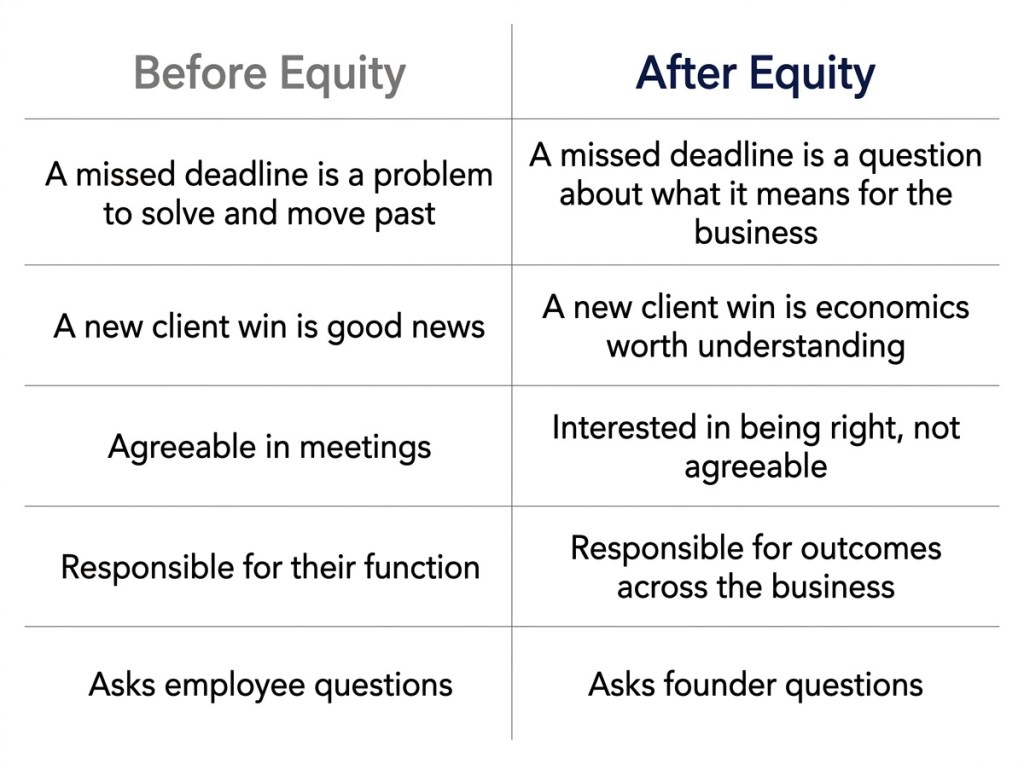
Before, a missed deadline was a problem to solve and move past. After, it became a question about why it happened and what it meant for the business as a whole, not just for the project in front of them. Before, a new client win was good news. After, it was good news they wanted to understand the economics of, not just celebrate.
They started asking questions that founders ask. Not because anyone told them to think that way. Because part of the business was now, quite literally, theirs.
That is the moment equity stops being a hiring tool and becomes something closer to a philosophy about who gets to think like an owner.
The thing nobody tells you about giving equity away.
Here is what surprised me most. I expected ESOPs to be a retention mechanism. A reason for good people to stay a little longer than they otherwise might.
What I did not expect was how much it would change the quality of the questions being asked inside the business. People who hold equity ask harder questions in meetings. They push back more, not less. They are less interested in being agreeable and more interested in being right, because being right now has a direct and personal consequence for them.
That is uncomfortable sometimes. It is also exactly what a growing business needs more of and gets less of as it scales, because the natural tendency in any company is for fewer and fewer people to feel personally responsible for outcomes as headcount increases.
Equity is one of the few tools that pushes against that tendency instead of accelerating it.
Why this matters more than the financial mechanics.
There is a version of this conversation that is entirely about dilution tables, vesting schedules and strike prices. That conversation matters and we have it carefully, with real diligence, because getting the mechanics wrong creates its own set of problems.
But the mechanics were never the point. The point was always what happens to a person’s relationship with the business once they hold a piece of it. The conversation I had reminded me of something I think founders forget too easily once the legal paperwork is signed and the grant letter is sent.
Equity is not the end of the decision. It is the beginning of a different kind of relationship. One where the person on the other side of the table is no longer just doing a job. They are building something they will eventually own a piece of.
That distinction is easy to write in a policy document. It is much harder, and much more important, to actually feel in a twenty minute conversation that was not supposed to mean very much.
It meant quite a lot.
Regards,
Rupesh
 Cloverbites By Rupesh Sanghavi
Leave a Reply