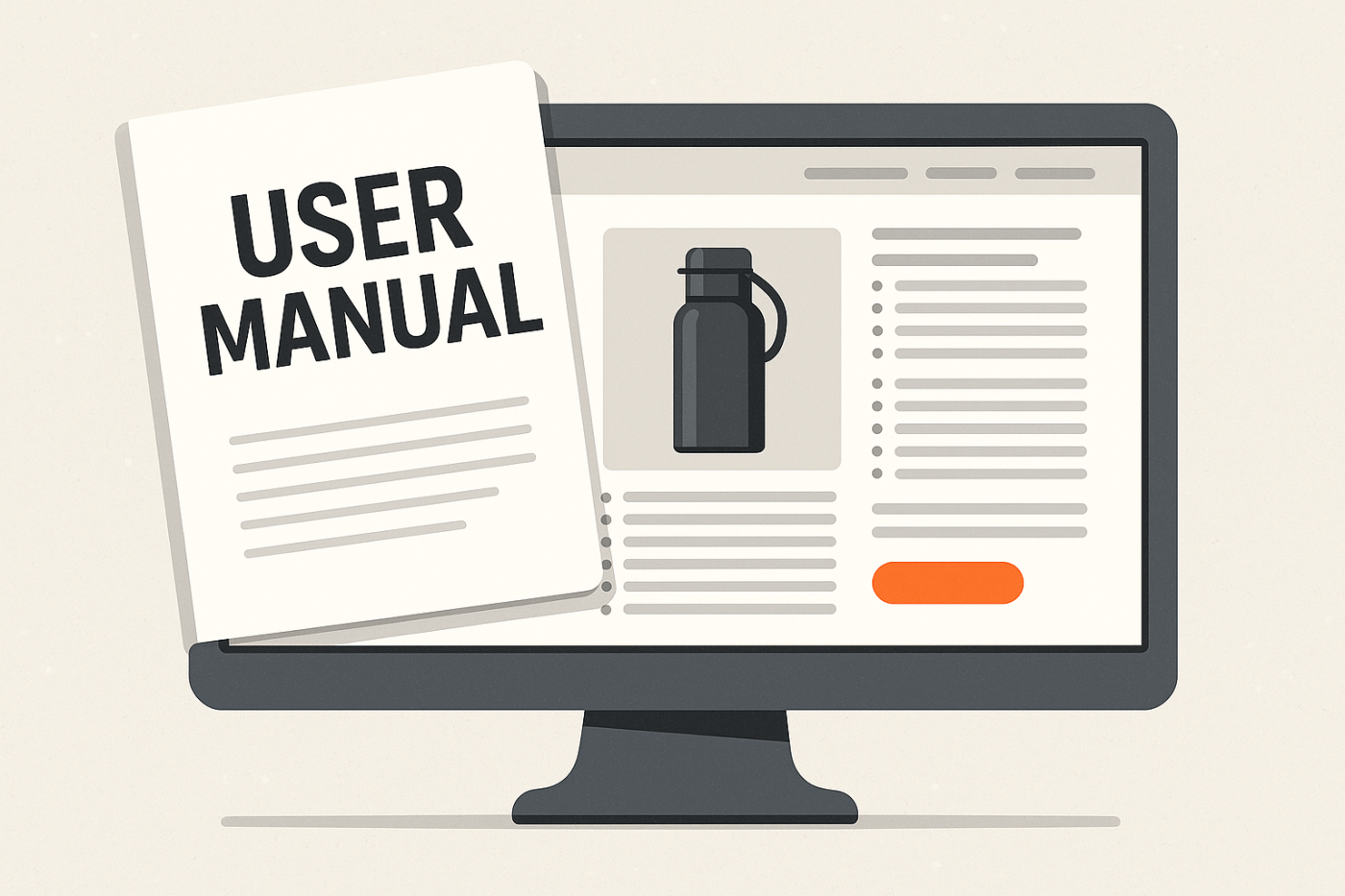
I once came across a product listing that gave me flashbacks to my chemical engineering days. And not the fun ones. I am talking about my final year thesis for Reaction Engineering. Technical specs, nested bullet points, and a proud little section on “cap threading design for torque retention.”
Except this wasn’t a reactor. It was a water bottle.
The listing read like someone wanted a patent, not a purchase. And this isn’t rare. I have seen this across categories, across brands, over and over. Product pages that sound like documentation. Listings that confuse detail with persuasion. Most of them are written to explain, not to sell. And then we act surprised when customers leave faster than a bad reaction in the lab.

People Do Not Buy Specs. They Buy What the Specs Do for Them.
Let’s be honest. Nobody wakes up excited about eleven temperature control settings. They want to know if your product makes their hair behave before a 7 p.m. dinner. They don’t care about triple-stitched ballistic nylon. They want to know if that backpack can survive TSA, two transfers, and still look good on their Insta story. Snap Snap!
Founders fall in love with features. Customers fall in love with outcomes. And most listings forget to bridge that gap.

Your Product Page Is Not a User Manual. It Is a Hook.
You get five seconds. Maybe less. That is your window. If your first lines read like a lab report, no one is sticking around to find out how great your foam density is. You might as well write “please click away” at the top.
A great listing talks like a person. It makes the reader feel something. It is not about what the product is made of. It is about what the product makes you feel like owning.
The Best Listings Sell the Outcome. Not the Object.
We tested this. Two listings. Same product. One listed wattage, voltage, and heating efficiency. The other said, “Heats up in five seconds so you can stop rushing out the door.”
Guess which one outsold the other? By a lot.
People remember what your product promises them. They don’t remember the numbers.

Stop Explaining. Start Creating Obsession.
You are not selling a product. You are selling a feeling. You are selling speed. Relief. Confidence. Calm. Convenience. A moment. And, we all love moments in our lives.
So unless you are trying to win an award for most accurate labeling, stop writing like you are submitting homework. Write like you want someone to fall in love with what they are about to buy.
Because if your product page feels like a user manual, they won’t read it. They will just bounce.
And no one obsesses over something they bounced from.Regards,
Rupesh
 Cloverbites By Rupesh Sanghavi
Leave a Reply