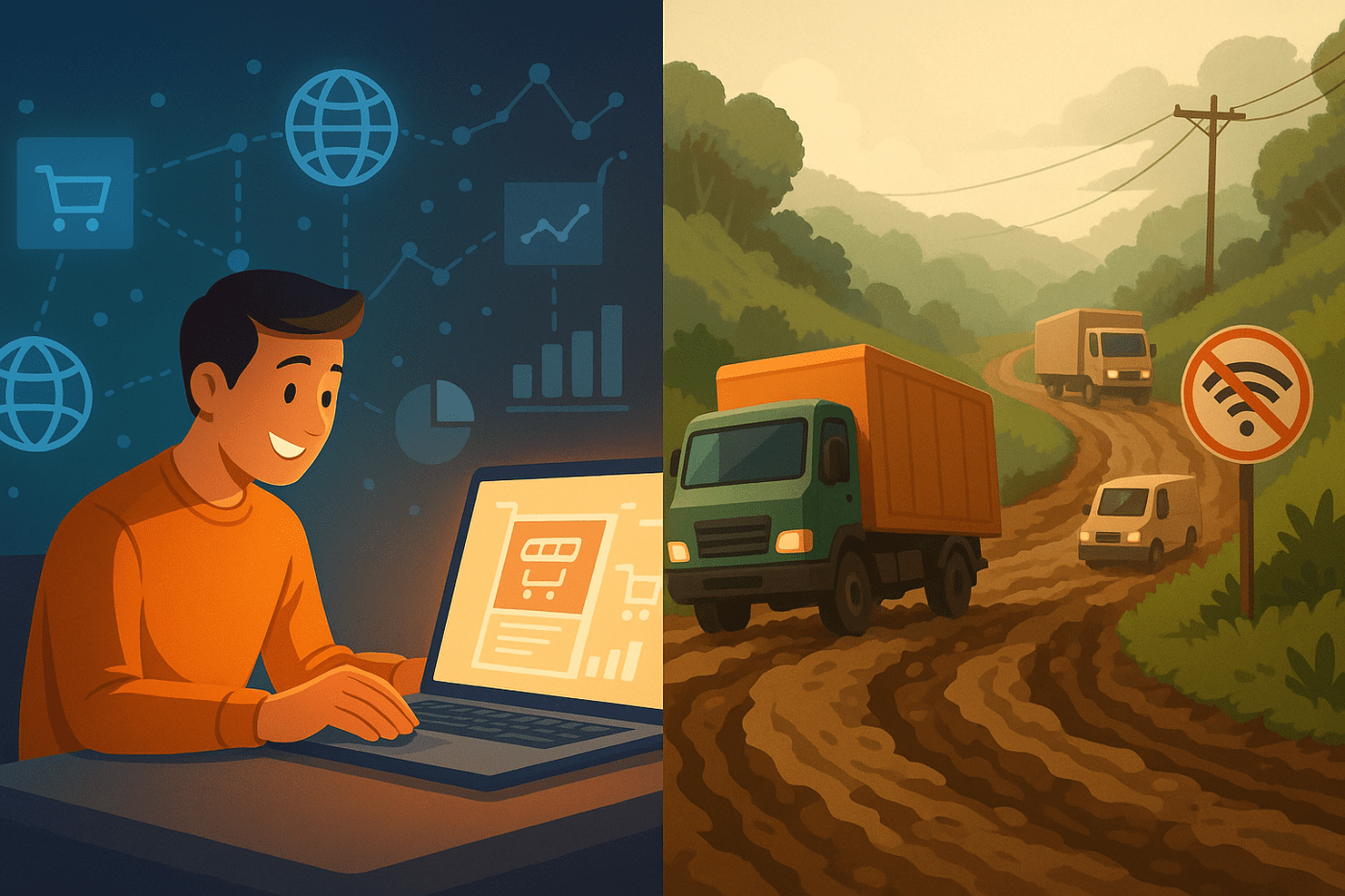
Remember when everyone said the internet would make everything equal? That kid in a village could compete with Amazon? That geography didn’t matter anymore?
Yeah, about that.
The Dream Sold vs. The Reality Delivered
The early promise was beautiful. Set up a website, list your products, and boom, you’re global. No storefront rent. No corporate overhead. Just you, your laptop, and the entire world as your customer base.
And it worked. Kind of. Southeast Asia’s digital economy hit $200 billion in 2023, up from $100 billion just three years earlier. Latin America’s e-commerce grew 37% in a single year. The charts looked amazing.
But here’s the part nobody mentions in the success stories.

Welcome to the New Barriers
Sure, anyone can sell online now. But can they actually reach customers? In sub-Saharan Africa, less than half the population can even get online. In rural India, only 37% have decent internet, compared to over 80% in cities.
And if you somehow clear that hurdle, there’s the delivery nightmare. Last-mile delivery costs in rural developing areas are up to 300% higher than in cities. JD.com’s president said it plainly: sometimes they have one or two packages in a rural area, and the cost is five times that of Beijing and Shanghai.
Ever tried setting up a wireless internet connection across a hill? Or through a forest? Water in plants disrupts wireless signals. Mountains block line of sight. And in autumn, falling leaves mess with equipment. Mother Nature didn’t get the memo about the digital revolution.
Who Actually Won?
Spoiler alert: not the scrappy underdog we all rooted for.
The real winners were people who already had advantages. Higher incomes. Better education. Urban zip codes. The folks who didn’t need e-commerce to level the playing field because they were already at the top of it.
E-commerce promised access to everyone. But pre-existing economic inequalities decided who could actually benefit. The digital divide didn’t shrink. It got wider.
The Hills Just Moved
Then there are barriers nobody saw coming. Countries slapped digital services taxes on U.S. tech companies, extracting over $9 billion in just four European countries between 2020 and 2024. New tariffs on electronic transmissions are being proposed, threatening decades of duty-free digital trade.
Online fraud in Southeast Asia jumped 20% between 2020 and 2023. Many regions still lack basic e-commerce laws, leaving everyone vulnerable.
Infrastructure gaps. Trust issues. Regulations that favor whoever writes them. Payment systems that don’t work. And a huge chunk of the population who can’t figure out how to navigate digital platforms.

The Honest Truth
E-commerce didn’t flatten the world. It created new mountains. Different ones, but just as steep if you’re starting from the bottom.
Does that mean it failed? No. Mobile money in Kenya grew from 37 million users in 2020 to over 50 million in 2023. India’s Digital India project mobilized over $1 billion for digital infrastructure. Progress is real.
But until we fix internet access, improve logistics, and ensure people have the tools and skills to compete online, e-commerce will continue to favour those who already have advantages.
The hills didn’t disappear. They just relocated. And for too many people, they’re still out of reach.
Rupesh
 Cloverbites By Rupesh Sanghavi
Leave a Reply