
Today, having a high emotional quotient (EQ) doesn’t mean being “sappy.” Rather, it refers to the attribute that makes leaders and non-leaders separate from each other; writes Daniel Goleman. He describes the popular concept of EQ as a combination of empathy, self-awareness, and socialization which has nothing to do with being “sensitive.”
Recent years have seen the 1990 theory of Goleman receive a lot of attention since leaders with EQ have outlasted the ones without it. The reason was simply that such leaders have the ability to understand the environment and respond appropriately in tough situations.
One can understand the impact a highly emotionally intelligent (EI) leader makes through the way they ‘acknowledge’ things around them.
Leader’s Who Know ‘Empathy’
Making big bucks isn’t the only goal of the richest person in the world. In the past few years, the individual hasn’t just made a hectocorn but also gained respect.
Bezos is known for Amazon and his strong leadership in building the giant. But, did you know that a lot of praise goes to his emotional intelligence rather than his technical skills? The cornerstone of EI is self-awareness and accepting what factor/situation can cause a trigger. Bezos understands it very well. Even when Amazon has allegations of being a callus workplace, Jeff avoided picking on his workers and opted for problem-solving. He defended workplace culture in front of the media and promised to create a better workplace for every Amazonian working with the company. Bezos’ acknowledgment of the problem showed how serious he is about his team members.
The presence of emotions in a leader extends a firm’s life. When emotionally intelligent leaders bring empathy and challenge-taking skills to the work culture, the firm improves exponentially. The presence of empathy encourages employees to trust the firm. Whereas, when it comes to tackling the challenges, Bezos handles it well. He knows difficult situations can impact the entire working of his firm, so he tends to act mindfully most of the time. From not laying off employees to being one of the first firms to acknowledge the ‘work from home’ model, Jeff Bezos has proved himself as a true leader in many circumstances.
In an interview, Jeff outlined the C-19 times as “the hardest time we’ve ever faced” and stated to spend his entire operating net profit on Covid-related issues. From getting products to customers to providing security to employees, the former CEO handled the pandemic remarkably well. His actions garnered appreciation and lifted the goodwill of Amazon.
Jeff isn’t the only emotionally intelligent leader scoring high. Tesla’s CEO Elon Musk is also in the line. Musk hustles 80 to 90 hours a week but still finds time to impress others through his empathetic behavior. Musk knows how to show appreciation, whether he’s displaying humor on Twitter or composing a thank you letter to Tesla owners. It is common for leaders to thank their supporters in the early days of taking office, but Musk doesn’t express his gratitude simply because he has to.
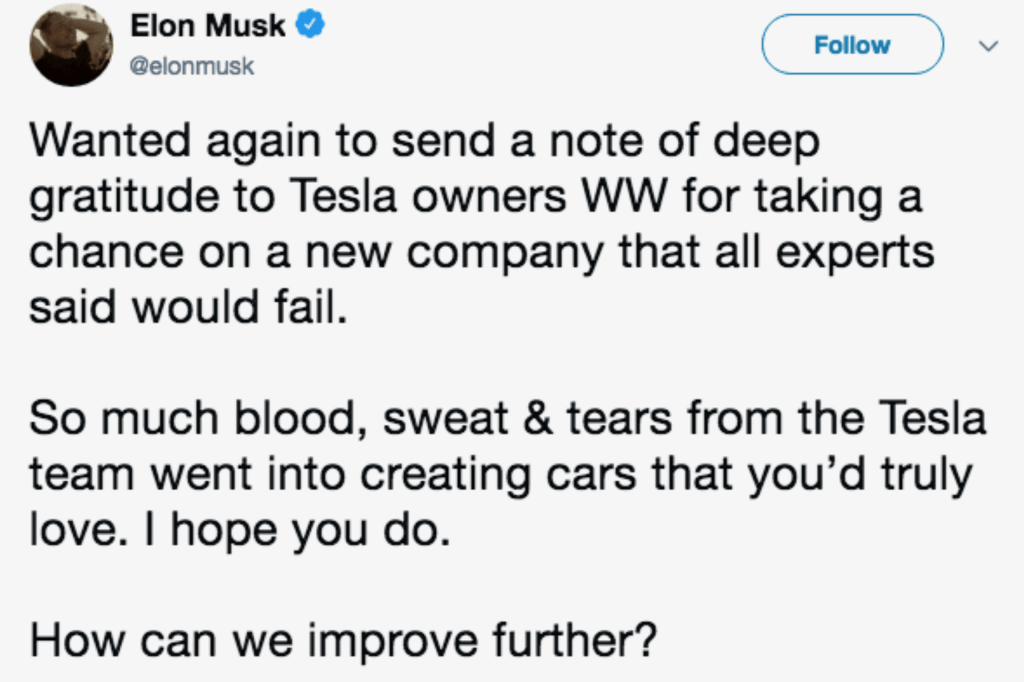
Good leaders have empathy built into their DNA. They care about everything in their immediate environment. When Tesla’s injury rate at its Fremont factory rose, Musk didn’t let HR handle the matter alone. His intervention in the matter was a clear sign that his actions are not focused on merely earning money. He visited the factory floor with the safety team to inspect what really went wrong. The leader performed all the tasks as injured Tesla staff. In an interview, Musk stated – “At Tesla, we lead from the front line, not from some safe and comfortable ivory tower.”
When it comes to emotional intelligence, actions speak louder than words. Musk’s willingness to work with frontline workers shows he values his employees as a leader. Despite not being able to do it every minute, this simple empathy exercise was motivating for the rest.
Richard Branson, Jeff Bezos, Sundar Pichai, or Elon Musk are all emotionally intelligent figures. They express their emotions from being physically present at the workstation to penning a heartfelt note on Twitter. Their actions result in thousands of followers applauding, but there’s something more! These leaders indirectly fetch benefits for their firm through their behavior.
Why does Emotional Intelligence Matter to Firms?
Emotionally intelligent leaders add an advantage to their firms as they create a productive workforce that reduces employee turnover.
The term emotional intelligence was coined by Peter Salovey and John Mayer in the 1990s. By 1996, Daniel Goleman had compiled it into a theory. In line with the theory, a leader with self-awareness, self-regulation, motivation, empathy, and social skills is most likely to improve company culture. Such leadership develops an open environment and a high level of engagement among the teams.
If a leader is autocratic, emotionless, and naive, then employees in the firm stay only for pay. Even the culture becomes toxic where employees are hesitant to unwind. When leaders are emotionally intelligent, stronger relationships and open communication flow naturally, resulting in engagement.
Undeniably, the benefits of an emotionally intelligent leader aren’t only engagement-related, they go beyond that. When employees see their leader as an idol or example, they’re most likely to follow them. The employees see their leader as an example and start trusting them. As a result, the workforce produces profitable results.
The Easy Recipe
Being aware of one’s own actions is the easiest way to become an emotionally intelligent leader. Successful leaders are aware of their emotions and trigger points. They are aware of their shortcomings and weaknesses. As a result, when the time comes for a serious decision or an important task, leaders would know how to proceed.
In a nutshell, Emotional Intelligence in a leader results in wonders. The world, even today, needs leaders who can build an environment where an employee never leaves.
 Cloverbites By Rupesh Sanghavi
Leave a Reply